The Tragedy of Fragmented Expertise: Why Your Fintech Will Fail
And Why Your CTO Probably Won’t See It Coming

There's a silent killer in payment system implementations that nobody talks about: the tragedy of fragmented expertise. It's the organizational equivalent of the blind men and the elephant, except you're building a system that handles money, regulatory compliance, and customer trust simultaneously.
And when it breaks, it doesn't fail gracefully. It fails expensively, publicly, and often illegally.
N26, once valued at $9B, was capped at onboarding just 50,000 customers per month by BaFin in 2021 due to AML compliance failures. They were fined €4.25M initially, then another €9.2M in 2024. The growth cap—down from their previous 170,000 customers per month—remained in place until June 2024. That's three years of throttled growth. CEO Valentin Stalf told the Financial Times "The impact on N26 surely amounts to billions of euros because it lowered the company's valuation as we were unable to grow."
Their crime? They built a great offering and achieved massive scale, but fragmented expertise between growth and compliance nearly destroyed them. Regulators established a precedent that infrastructure must precede expansion. Don't build a high-octane performance engine for Product if you only have a rusty bicycle chassis for Compliance: regulators don't want you hitting the gas if you don't have the brakes wired up.
Why Mobile Payment Schemes Are a Different Beast
There's a core tension in regulated industries like payments:
Product and Engineering work tirelessly to reduce friction. Regulators require you to introduce friction.
This conflict is why the solution is not a set of specialists, but an Integrated Payments Expert: a single mind who can navigate the entire loop. Without this expert mediator, you pay a steep coordination tax.
Forget what you know about integrating with Stripe or PayPal, building a payment scheme is different: you are the scheme. You are creating a new payment instrument with its own regulatory identity. You own compliance end-to-end. There’s no processor to blame when regulators come knocking. Every technical decision you make has regulatory implications you must understand.
The Four Horsemen: Where Payment Dreams Go To Die
Mobile payment schemes require simultaneous mastery of four distinct domains. Miss any one, and you're building a time bomb:
- Legal/Compliance: The Regulatory Labyrinth (e-money licensing, PSD2, AML/KYC, consumer protection).
- Engineering: The Technical Minefield (account ledger design, transaction atomicity, mobile SDK security, webhook reliability).
- Product: The UX Tightrope (onboarding friction vs. conversion, authentication flows, transaction limits).
- Business: The Unit Economics Trap (interchange fees, fraud loss prevention, treasury operations, float revenue).
Real-World Carnage: The "Simple" QR Code Payment
Let me show you where this goes wrong in practice. Your product team comes to you with a straightforward feature request:
"Users should be able to pay merchants by scanning a QR code. Show the amount, swipe to confirm, payment happens instantly."
Sounds simple, right? Every payment app does this. How hard could it be?
Buckle up.
The Compliance Reality (Where The Rubber Hits The Road)
Your legal counsel joins the design review:
Legal: "This payment flow doesn't implement Strong Customer Authentication correctly."
Engineering: "What? We're using biometric authentication. That's SCA."
Legal: "You need dynamic linking. The authentication must be bound to the specific payment amount and merchant. Your current flow authenticates the user, not the transaction."
Product: "That's only for e-commerce. This is a POS transaction at a physical store."
Legal: "Regulators consider POS consumer scans as remote transactions. PSD2 RTS Article 4 requires it.
Engineering: "...what does that mean technically?"
Legal: "I don't know. I just know it's required."
Now you need to redesign your auth flow for dynamic linking to meet a regulatory requirement that neither legal nor engineering fully understands without deep payments expertise.
But wait, it gets worse!
Legal: "What's this
stable_user_ref
being
sent to a third-party?"
Product: "Our partner needs it for AML compliance."
Legal: "I don't recall us reviewing this for GDPR compliance..."
Product: "What are you even talking about? It's just some random value, how could it possibly be related to GDPR compliance?"
Legal: "It doesn't matter if it's random to us. If this partner can correlate user information to this value, then regulators treat it as PII. We can't ship this without determining proper GDPR Controller Relationships first. But let's keep that for another alignment and coordination meeting. Can someone send out meeting invites, please?"
Business: "When do we settle funds to the merchant?"
Product: "We wanted instant, but most issuer can only do T+1. What if the issuer goes bankrupt, we'll still make the merchant whole, right? They'd still get their money? Merchants keep asking about payment guarantees."
Legal: "Absolutely not: we're not licensed to be a settlement central counterparty. No payment guarantees to acquirers."
Product and Engineering: "...I thought we were just building a QR code payment feature?"
The Coordination Tax is Brutal
You might think "every complex system has coordination overhead." But payment schemes are special kinds of hell: a "simple feature" explodes into a four-way negotiation between domains that speak different languages and optimize for incompatible goals.
What was estimated as 2 weeks of engineering work took 10 weeks. Your velocity just dropped by 5x.
This coordination creates a massive tax on your burn rate:
- Coordination Overhead: Specialists spend 45+ person-hours per week of pure overhead just translating terminology, reconciling conflicting advice, and waiting for approvals.
- Executive Time Multiplied: Your CTO and CEO will spend 12+ hours per week bridging these gaps; time that should be spent on strategy and fundraising.
Now multiply this by every feature you're building.
At C-level hourly rates, this coordination overhead costs more than just hiring the integrated expert in the first place.The Mythical Payments Expert (And Why You Can't Find Them)
The solution is obvious: hire someone who understands all four domains. This person sits at the intersection, owns end-to-end judgment, and prevents fragmentation. This person is rare because their expertise requires simultaneous mastery:
- 5+ years in payment systems engineering (ledgers, atomicity, distributed systems).
- 3+ years in payments compliance (PSD2, AML, living through audits).
- Product experience (balancing fraud prevention with conversion).
- Business acumen (modeling unit economics and fraud loss).
You cannot train someone into this role in 12 months.
And here's the brutal part: even if you find this unicorn, they're a bottleneck at scale. Every payment decision flows through them. They're in every meeting, reviewing every spec, unblocking every team.
The False Economy
C-level executives often try to save money by hiring specialists (engineer + legal consultant + backend developer), assuming it's cheaper than one expert.
This fails 90% of the time. When things go sideways, accountability evaporates: the engineer blames legal, legal blames architecture, and no one owns the end-to-end problem. You get the coordination cost and the compliance risk. Worse, there are never any lessons to be learned, because it was never anybody's fault.
The Survival Playbook (If You're Already Drowning)
Even "simple" features touch multiple domains at once. Below is a compact map of the interaction surface:
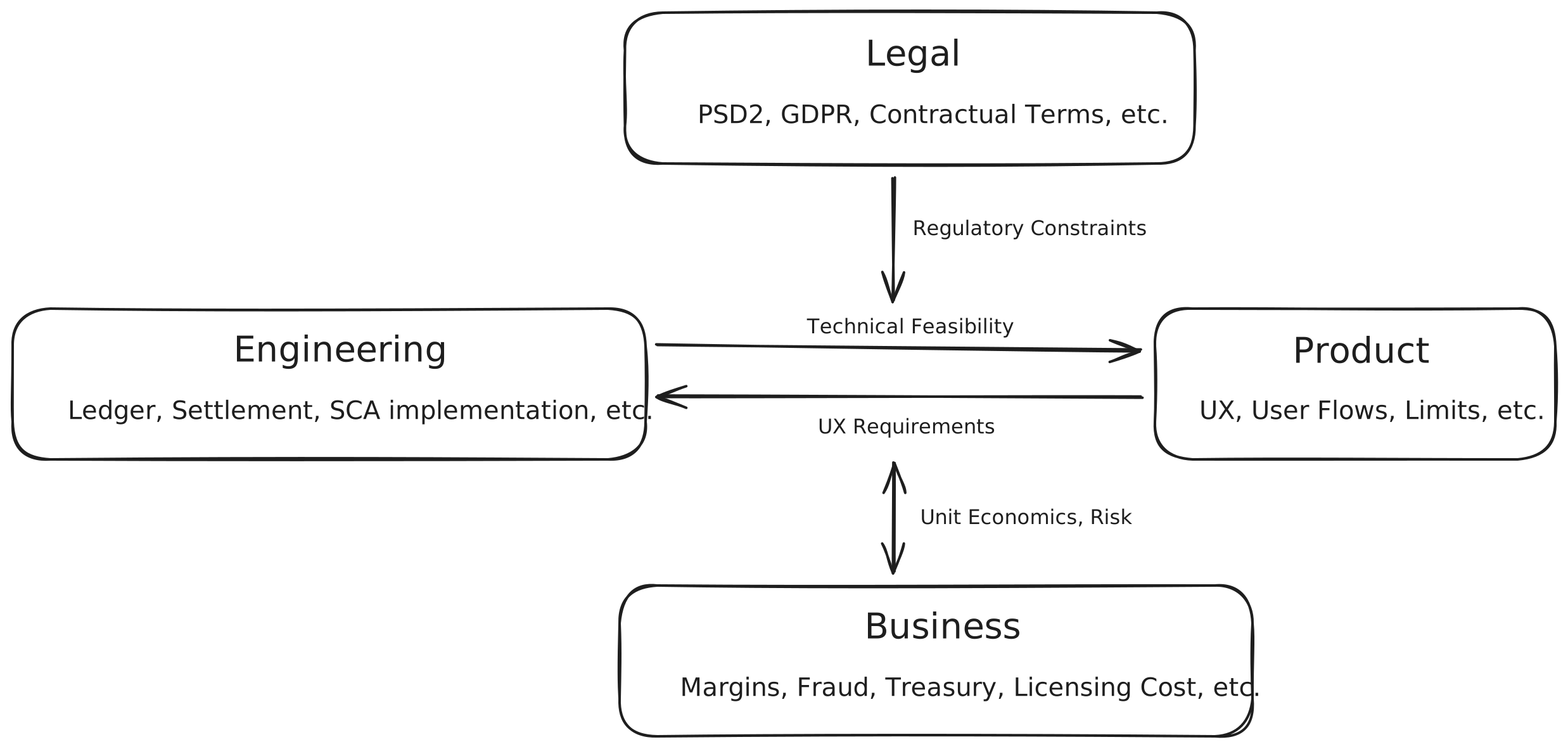
Every arrow represents a place where fragmented expertise creates delays, contradictions, or regulatory exposure. The system only behaves predictably when a single mind (or a tightly-integrated function) understands the entire loop.
If you're building a mobile payment scheme with fragmented expertise, here's how to survive:
1. Map the Decision Dependencies
Create a matrix showing which decisions require which domains:
| Feature | Engineering | Legal | Product | Business |
|---|---|---|---|---|
| QR Payments | ✓✓✓ | ✓✓ | ✓✓ | ✓ |
| Instant Settlement | ✓✓ | ✓ | ✓ | ✓✓✓ |
| KYC Flow | ✓ | ✓✓✓ | ✓✓ | ✓ |
| Dispute Resolution | ✓✓ | ✓✓✓ | ✓✓ | ✓✓ |
✓✓✓ = Critical involvement needed
✓✓ = Significant involvement needed
✓ = Input needed
Before starting any feature, know your coordination surface area.
2. Front-Load Compliance Review
Don't design first, then check compliance. Start with compliance constraints, then design within them.
Process:
- Legal documents regulatory requirements upfront
- Engineering designs technical approaches that satisfy requirements
- Product designs UX within technical constraints
- Business validates unit economics
This inverts the normal flow but prevents expensive redesigns.
3. Document Regulatory Decisions Like Code
Every regulatory interpretation needs documentation:
## Decision: Dynamic Linking Implementation for SCA

**Regulation:** PSD2 RTS Article 4 requires authentication to be
dynamically linked to transaction amount and payee.

**Interpretation:** Transaction signing must include amount and
merchant ID in the authentication challenge and any change to these
invalidates the authorization.

**Implementation:** Mobile SDK generates signature over
{amount, merchant_id, payment token, timestamp} using the device
wallet's private key. Backend verifies signature and payment token
before processing payment.

**Alternative considered:** Session-based authentication
**Rejected because:** Does not provide binding to
specific transaction parameters, and stronger binding isn't more
expensive to implement and deliver.

**Regulatory risk:** If wrong, payment transactions may be deemed
non-compliant with SCA requirements.

**Date:** 2024-11-15
**Reviewed by:** [Legal], [Engineering], [Security]
**Next review:** 2025-11-15
When regulators audit you, this documentation is the difference between "demonstrable compliance" and "shutdown."
4. Build Compliance Directly Into Architecture
Don't bolt compliance on afterward. People follow the path of least resistance, so make compliance the easy path and make the non-compliant path impossible.
Bad Architecture:
// Engineer can bypass AML checks
async function createAccount(userId, accountData) {
  const account = await db.createAccount(accountData);
  // TODO: Add KYC check here
  return account;
}
Good Architecture:
async function createAccount(userId, kycData) {
  // Compliance rules enforced at type level
  const verifiedKyc = await kycService.verify(kycData);
  if (!verifiedKyc.passedAML) {
    throw new ComplianceError("AML verification failed");
  }

  const account = await db.createAccount({
    userId,
    kycLevel: verifiedKyc.level,
    transactionLimits: getLimitsForKycLevel(verifiedKyc.level)
  });

  await complianceLog.record("ACCOUNT_CREATED", {
    userId,
    kycLevel: verifiedKyc.level,
    timestamp: Date.now()
  });

  return account;
}
5. Accept the Velocity Tax
Mobile payment schemes move slower than other products. Accept it. Budget for it, and set expectations with investors and board accordingly. Underpromise, overdeliver.
6. When You're Ready: Pay for Integrated Expertise
The integrated expert pays for themselves in 3-6 months through velocity gains alone, and can prevent fines in the millions.
If you're building a payment scheme, the question isn’t whether you need integrated expertise; it’s when the cost of not having it becomes irreversible.
No single specialist can prevent alignment quagmires, because the problem isn’t the absence of skill, it’s the absence of synthesis.
If your company is already handling real funds at scale (or plans to) you don’t need three specialists: you need one person who understands the whole chessboard.
A Quick Reality Check
Building a mobile payment scheme is hard. Harder than most founders realize when they start.
You're not building a fintech app. You're building regulated financial infrastructure that moves real money under regulatory supervision.
The tragedy of fragmented expertise is real, expensive, and kills most attempts: the harsh reality is that excellence in payments doesn't guarantee success, but regulatory mistakes absolutely will end you.
You can mitigate it through:
- Brutal honesty about what you don't know
- Compliance-first architecture that makes violations impossible
- Ruthless documentation of regulatory interpretations
- Strategic hiring of integrated expertise when you can afford it
- Realistic velocity expectations with investors and board
Now go build your mobile payment scheme. And when you're trying to decide between hiring three specialists or one expensive payments expert, remember: the most expensive hire is the one you should have made six months ago. And if you're already six months late, stop digging. Get the expertise in the room before you write another line of legacy code.